
Every attachment supplier claims wear-resistant steel and precision manufacturing. On a quotation sheet the words look identical. On a job site after two seasons, they do not.
This is a plain explanation of the three things that decide how long a demolition attachment lasts — and how a buyer can check each one before signing.
1. The steel grade has a certificate behind it
Hardox is a brand of wear plate from SSAB, and it is not the only abrasion-resistant steel on the market. What distinguishes a certified tool is that the grade is documented, batch by batch, rather than asserted.
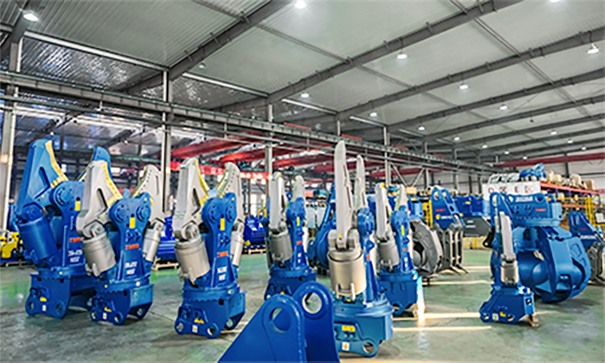
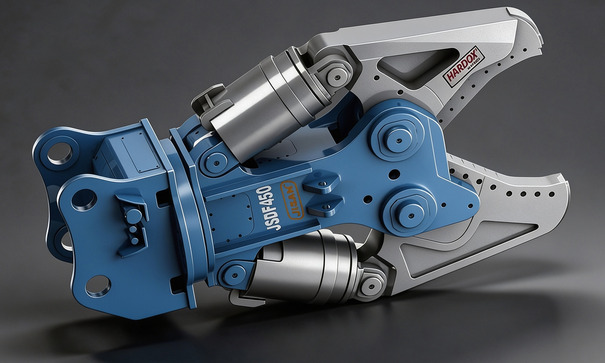
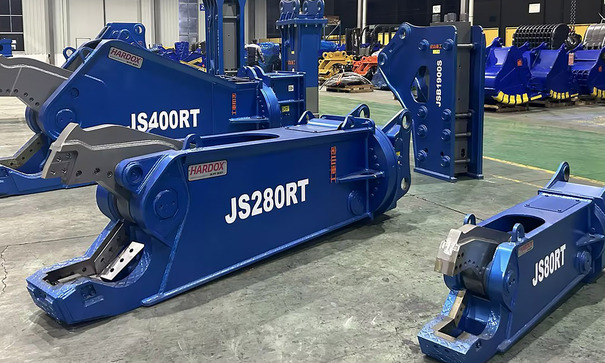
JISAN has held Hardox In My Body membership since 2020 and has renewed it through 2026. Membership is granted by SSAB to manufacturers who use genuine Hardox plate and meet its requirements on design and production technique; the certificate lists the specific product families it covers — in our case the JSDF dual-cylinder power shears and the hydraulic power shear range.
Why it matters commercially: Hardox wears at roughly a quarter to a fifth of the rate of ordinary structural plate in abrasive shear duty. A jaw that holds its edge longer is not a comfort feature. It is fewer re-facing hours, fewer stoppages and a tool that still has resale value after three years of scrap work.
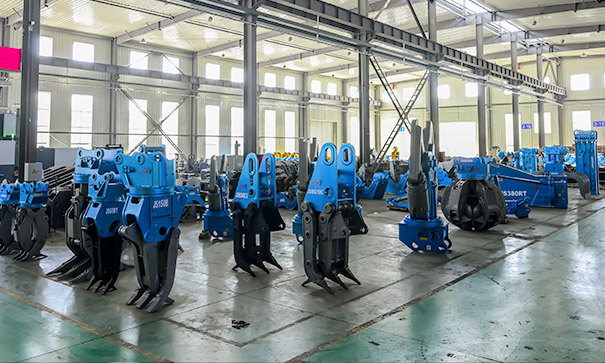
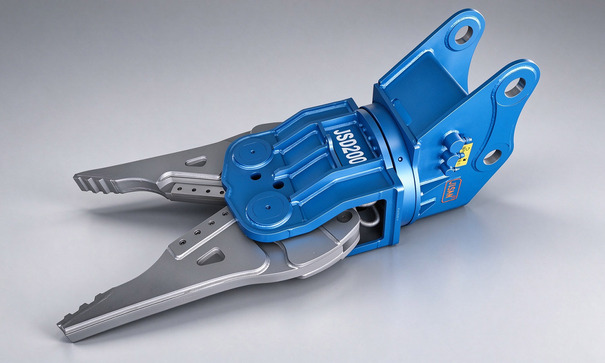
For grapple and grab bodies the calculation is different. There, the structure needs stiffness more than abrasion resistance, so the body is built from Q355B manganese plate — yield strength above 355 MPa, roughly 50% higher than ordinary carbon steel — with Hardox wear strips bonded at the tine tips, jaw faces and edges where material actually rubs.
2. Welded first, machined after
This is the least visible and most consequential detail in a shear.
A shear‘s upper bracket carries the main pivot bores. The conventional route is to cut the bracket in sections, machine them, then weld them together. Welding heat distorts the assembly; the bores move out of line by a few tenths of a millimetre; the pin no longer sits square. The symptom appears months later as a shear that "spreads" or "splits" under load, and the usual field fix is to ream and re-bush.
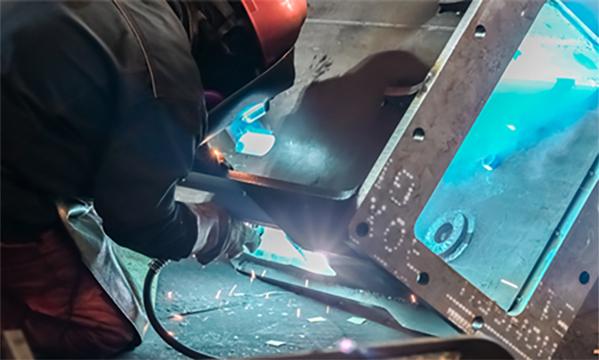
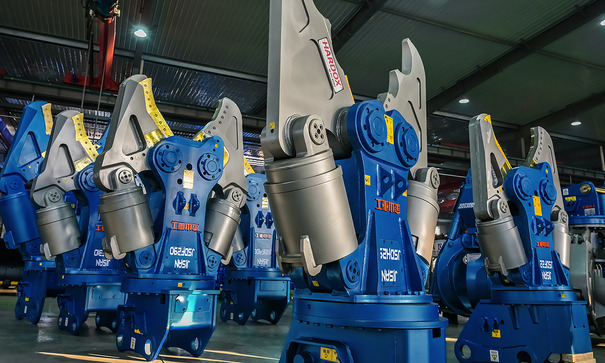
JISAN fabricates the complete bracket, welds it, and only then machines it in one setup on a large gantry machining centre. Alignment is established after the heat has done its work. The measurable result is that the jaw halves stay parallel through the stroke, which is what keeps the blade gap consistent and stops material from wedging.
Ask any supplier which sequence they use. The answer is either "weld then machine" or "machine then weld", and it tells you more about durability than the paint finish does.
3. Warranty terms you can hold them to
In this category, six to twelve months is the common standard. JISAN‘s terms are two years on dual-cylinder shears, one year on grapple and grab products, with an automatic one-month extension at the end of the covered period.
Longer coverage is only meaningful if parts arrive. Our stated service sequence is: response within 10 minutes, proposed solution within 30 minutes, replacement part dispatched within 8 hours, engineer on site within 24 hours for faults that cannot be resolved remotely. For export customers, wear parts and seal kits are stocked against the attachment model rather than ordered on demand.
The commercial version of the same argument
Attachments are not consumables; they are capital equipment with a resale market. Three things protect the residual value: a tool that has not been repeatedly re-welded, a documented material grade, and a service history with no major failure. Buyers of used equipment check exactly these — which is why a certified, one-piece-machined shear typically holds a noticeably higher second-hand price than a welded assembly of the same nominal tonnage.
How to verify before you buy
• Ask for the Hardox In My Body certificate and check the product families listed on it.
• Ask whether the pivot bracket is machined before or after welding.
• Ask for the warranty document, not the warranty sentence in a brochure.
• Ask which wear parts are stocked locally and what the lead time is.
If a supplier cannot answer the second question precisely, the first and third matter less.
JISAN Heavy Industry — demolition shears, crushers, grapples and buckets, manufactured in Yantai, China, and supplied to customers in more than 50 countries.