• Home

  • Attachments

  • Technology

  • Manufacturing

  • News & Media

  • About Us

  • Contact Us

Home > News & Media > Industry Insights
The Maintenance Calendar Most Excavator Owners Get Wrong

Most excavator failures are not caused by worn-out machines. They are caused by maintenance being done late, done on the wrong interval, or done with the wrong fluid — and the owner only finds out when a component fails early.

This is a practical schedule for the four fluid systems and the consumables that most often get deferred. It applies to the carrier, but the same discipline governs the attachment on the end of it.

Engine and hydraulic oil

Oil degrades under heat and pressure even when it looks clean. The inspection that matters is not colour, it is interval.

• Change on schedule regardless of appearance. Oil that "still looks fine" at 250 hours is often already outside its viscosity band.

• Contamination is the main failure route. Water, metal particles and dust entering the system cause the majority of hydraulic faults; filtration and clean handling at top-up matter more than oil brand.

• Never mix grades or brands. Two oils of the same nominal grade can have incompatible additive packages, and the result is sludge rather than lubrication.

• Fill to the specified quantity. Overfilling aerates the oil, underfilling raises temperature; both shorten pump life.

• Change the filter with the oil every time. A new charge of oil through an old filter is a false economy measured in weeks.

Coolant

• River water is not a substitute. Calcium and suspended solids scale the radiator and the engine water jacket, and scaled surfaces transfer heat badly — which reads on the gauge as overheating under load.

• Factory coolant is designed to protect the system for around two years or 4,000 hours. It can be used in hot climates; the concentration is what changes, not the product.

• Coolant is flammable. Keep it away from heat sources and never open a pressurised cap on a hot engine.

• Mix ratio follows ambient temperature, not habit. A weak mix protects against neither freezing nor corrosion.

• Top up only when the engine is cold. Air trapped in a hot system causes local boiling and false readings.

• Low level means overheating; entrained air means corrosion. Both are visible as discoloured coolant long before they become a breakdown.

Filters

• Replace on the specified interval, and shorten it in dusty conditions or with high-sulphur fuel.

• Never clean and reuse a cylindrical filter. The pleats hold what they catch; washing pushes it through.

Hoses and rubber parts

Low-pressure return hoses, high-pressure lines and rubber water pipes age from the inside. They fail without warning, and a burst high-pressure line near a hot manifold is a fire, not a leak.

The rule for these parts is replacement by calendar, not by inspection. Degradation inside a hose is not visible from outside, and by the time it shows as a bulge or a weep, the margin is gone.

The attachment on the end

The same logic applies to the tool: pivot pins and bushings on a schedule, jaw inserts before they are past the wear limit, blade bolts checked at every service. A shear that is maintained on the carrier‘s service interval lasts materially longer than one that is greased when someone remembers.

Need the service intervals for a specific attachment? The manual ships with every unit, and the current version is available on request with the serial number.
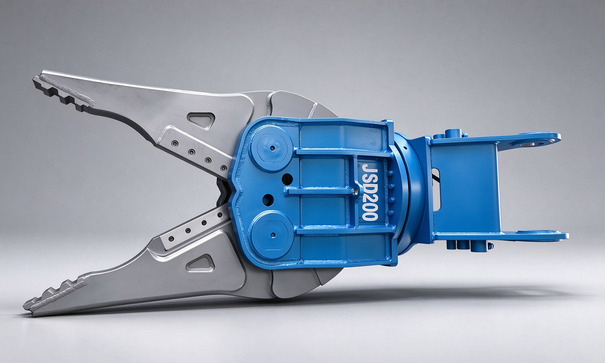
A dismantling yard in Shandong processes end-of-life vehicles with four machines and one operator sequence. From the moment the car is clamped to the moment the shell is flat and the drivetrain is cut free, the clock runs about seven minutes. That number is not a lab figure. It is the yard‘s own production average, and it is the reason the same site reduced headcount on the dismantling line by roughly 60% without reducing throughput. Where the time actually goes Manual dismantling is slow for a structural reason: the work is sequential and every step depends on a tool change. Drain fluids, remove the battery, cut the doors, pull the harness, separate the engine, cut the frame, compress the body. Two to three hours per vehicle is typical, and most of that is not cutting — it is handling, repositioning and waiting. An attachment-based line removes the repositioning. Four tools, one carrier, one continuous flow: • Dismantling machine with a dismantling clamp — large-jaw geometry that grabs a body shell and peels doors, bonnet, seats and harness without flame. • Press frame — compresses the stripped shell so it stacks and transports at a fraction of its original volume. • Dual-cylinder power shear — cuts chassis rails, 20 mm plate and high-strength alloy structure that a clamp cannot bite through. • Eagle shear — where a cleaner, lower-loss cut is needed on thinner sections and mixed material. Why no flame matters more than it used to Thermal cutting is still common, and it is increasingly the constraint rather than the solution. Open flame means fume extraction, fire watch, hot-work permits and insurance exposure; in many jurisdictions it also means a permit condition that caps daily volume. Mechanical cutting removes that ceiling. There is a second, quieter advantage: a shear produces graded, sized scrap. A burned chassis produces material that mills discount. Yards running mechanical dismantling typically see a better price per tonne on the ferrous fraction, because the yard is selling cut scrap rather than contaminated plate. The three specifications that decide whether it works Not every attachment survives this duty cycle. Three specifications separate a tool that lasts from one that cracks in the first season. 1. Jaw material. JISAN shear jaws and wear plates are cut from SSAB Hardox plate, certified under the Hardox In My Body programme. In continuous ELV work, jaw hardness is the difference between re-facing once a year and re-facing once a quarter. 2. Bore alignment after welding. Shear brackets are usually fabricated in sections and welded afterwards; the weld pulls the bores out of line, and the pin starts working loose. JISAN welds first and machines the bracket as one piece, so alignment is set after the heat is gone. 3. Hydraulic headroom. A 7-minute cycle is a high-frequency cycle. Cylinders use honed tube and imported NOK seals, with a differential acceleration valve that speeds the unloaded stroke by close to 50% — which is where most of the cycle-time gain actually comes from. What it means for a yard‘s numbers For a mid-size operator, the shift is usually visible in three places: vehicles processed per shift, labour cost per vehicle, and the price received for the ferrous fraction. One site running the full sequence reports up to 70 vehicles per shift at peak, against a manual baseline of a dozen or so. The equipment also has to fit the carrier fleet. All four tools mount on standard excavators in the 20–55 t range with a quick coupler, so a yard can add capacity without buying a dedicated machine. Next step Tell us your carrier tonnage, the vehicle mix you process and your current cycle time. We will lay out the tool sequence, shear force requirement and expected throughput — and be honest about where a shear is not the right answer. JISAN Heavy Industry manufactures demolition shears, crushers, grapples and dismantling attachments in Yantai, China, and supplies customers in more than 50 countries.

Seven Minutes a Vehicle: What Changes When Dismantling Stops Being Manual

Nov.21.2026

The slewing ring and its reduction gear are the most expensive wear assembly on an excavator, and the maintenance regime most often applied to them is exactly backwards. Owners grease the ring every day and change the gear oil when they remember. The correct schedule is the opposite: infrequent, generous greasing of the bearing, and disciplined inspection of the gear cavity. How the cavity fills with water Under the boom foot there is an inspection cover. Removing it gives a view into the gear cavity, where the ring gear, the pinion and the grease sit. Between the cavity and the outside world there is a dust seal at the centre joint. That seal ages. Once it hardens or splits, rain running down the centre joint goes straight into the cavity. The water dilutes the grease, the grease stops carrying load, and the ring gear starts wearing against a film that is no longer lubricating. The sequence from there is predictable: dilution, accelerated tooth wear, pitting, flaking of the tooth surface, and eventually noise on slew. By the time the operator hears it, the gear is usually past saving. What to actually do • Inspect the cavity at 2,000 hours or annually, whichever comes first. Open the cover under the boom foot and the square plate at the front of the undercarriage. • Grease quantity for a 20-tonne class machine is around 36 litres — roughly two standard drums — at each service. Under-greasing is the common error here, not over-greasing. • If water is present, drain it from the access plate in the cavity below the ring, then regrease fully. Do not simply add grease on top of water. • Replace the centre-joint dust seal when it hardens. It is an inexpensive part that prevents an expensive failure. The bearing itself: less is more Slewing ring bearings are commonly over-greased because owners apply the same daily routine as the boom and arm pins. The result is the opposite of what is intended. Excess grease pressurises the bearing cavity, forces the dust seal out, and creates the gap through which contamination enters. Once the seal is displaced, grit reaches the raceway and the bearing fails early — often within a season. For a standard excavator, one greasing per week is adequate. Machines in wet or dusty conditions may need more frequent inspection, but the answer is inspection, not a heavier schedule. The commercial case A slewing ring replacement is one of the largest single repair costs on a 20-tonne machine, and it is almost always the consequence of a seal that cost a fraction of it. The maintenance cost of getting this right is a drum of grease and an hour of labour per service. Running a fleet and standardising service intervals? We can supply the attachment-side intervals and the wear-part list that pairs with them, so the carrier and the tool are serviced on the same schedule.

Slewing Ring Maintenance: The Interval Almost Everyone Shortens by Mistake

Nov.21.2026

Oil weeping from the front cover and around the chisel is one of the most common breaker complaints, and the most common response — replace the chisel — is usually wrong. The chisel is a consumable, and a worn one does need replacing. But when oil appears at the front cover, the seal that has failed is upstream of the chisel, and fitting a new chisel without addressing it simply consumes the new part faster. What the leak is telling you The front cover carries the wiper and the main seal that keep the percussion chamber closed. When oil appears there, one of three things has happened: • The main seal on the piston head is damaged. This is the usual finding, and it is often caused by debris — a fragment of a broken chisel tip or a sliver of hard material — carried into the seal and folding its lip. • The chisel has been running dry. Insufficient grease at the chisel shank wears the bushing, which then loads the seal unevenly. • The chisel is misaligned in the bore. Usually the result of operating at an angle rather than square to the work. A seal with a folded lip does not reseat. It scores the piston as it moves, and the scoring produces the metal particles that finish the job. The two operating errors behind most of it In practice, two habits account for the majority of these failures. Idling on the trigger. Running the breaker without contact with the material — "blank firing" — sends the piston into the chisel with nothing to absorb the energy. The shock travels back through the tool and into the seal and bushing. It is the single most destructive thing an operator can do to a breaker, and it is invisible on a timesheet. Working off-square. Holding the breaker at an angle to the surface loads the chisel in bending rather than in compression. The chisel is designed for axial load; bending load wears the bushing oval and lets the chisel rock in the bore, which is what finally destroys the seal. What to do • Stop using the breaker and strip the front end. Inspect the chisel shank for scoring and the bushing for ovality. • Replace the piston main seal. If the chisel is only lightly worn — no chipping at the tip, shank within tolerance — it can go back into service. • If the chisel tip is chipped or the shank is worn past the limit, replace it. A worn chisel transfers impact into the tool body instead of the material, and the efficiency loss is measurable long before the part fails. • Check the grease supply to the shank. Dry running accounts for a large share of repeat failures after a repair. Preventing the next one The breaker is the attachment with the shortest service interval in most fleets, and the one most often operated by the least experienced hand. Three rules cover most of the risk: never fire without contact, keep the tool square to the work, and grease the shank on the specified interval — more often in wet, muddy or dusty conditions. Matching a breaker to a carrier, or replacing a front end? Send us the model, the serial number and photos of the chisel shank; we will confirm which parts are in stock and whether the tool body needs inspection.

Oil at the Breaker Front Cover: Diagnosis Before Replacement

Nov.21.2026

Dynamic compaction — dropping a heavy tamper from height to densify loose ground — is simple in principle and unforgiving in practice. The equipment is a crawler crane or an excavator-mounted compactor, and the variables are the drop height, the number of passes and the grid. Get those right and the ground improves measurably; get them wrong and the site looks compacted while the bearing capacity has barely moved. Clear the zone before anything drops The tamper does not stay where it is aimed. Impact throws material, and the crane‘s boom can swing. The working zone needs to be clear of people and plant before the first drop, with a perimeter marked beyond the throw distance and warning signage at the boundary. On a site with other trades working, this is the part that gets negotiated away first. It should not be. A tamper weighing several tonnes falling from 10-15 m is not a hazard that can be managed by vigilance alone. Weather matters more than most specifications admit Compaction in rain does not simply work less well — it can work against you. Water in the pores raises the pore pressure under impact, and the ground deforms rather than densifies. The result is a surface that reads firm and a layer beneath that is still loose. The practical rule: do not run the compactor in sustained rain, and do not resume immediately after it. Allow the surface to drain, and check the moisture condition before restarting the grid. The machine side Dust is the main enemy of the equipment, and it is generated by the work itself. • Clean the air intake and the cooling pack at the end of every shift, not weekly. • Inspect the rope, the release mechanism and the guide on the specified interval; these are the parts that fail under cyclic load. • Keep the tamper face flat. A worn or dished face transfers impact unevenly and leaves the grid with soft spots between drops. The operator side Three habits separate a productive compaction programme from a slow one: • Hold the grid. Moving the drop points to "fill in" a soft spot breaks the pattern and leaves the rest of the area under-compacted. • Count passes, do not estimate them. Bearing capacity comes from the number of energy applications, not from time spent on site. • Watch the machine, not just the ground. A change in the sound of the drop or in the rebound usually indicates the ground has reached refusal in that spot — or that something in the release mechanism is binding. Verification Compaction is one of the few ground improvement methods where the result cannot be judged by eye. Plate load tests or dynamic penetration tests at the specified grid points are what convert "it looks compacted" into a number a structural engineer can sign against. Specifying compaction equipment for a site? Tell us the ground condition, the target depth of improvement and the carrier available; we will match the compactor size and the drop height to the requirement.

Dynamic Compaction: Site Rules That Decide Whether the Job Works

Nov.21.2026

Experienced operators diagnose a machine by ear before anyone reaches for a gauge. The skill is not mystical — it is pattern recognition against a small set of mechanical causes, and it can be learned in the order below. One caveat first: a working site is loud, and noise carries through the structure. Diagnose at low speed, in a clear area, with the machine at operating temperature. Driveline noise that changes with speed A humming or whining noise that rises with road speed, becoming a knock in turns. This pattern points to the differential: excessive backlash between the planetary gears and the side gears, worn or broken tooth faces, or a cracked gear. The repair is to re-shim to the correct backlash or replace the damaged gear set. Continuing to run it converts a shim job into a differential rebuild. A repetitive knock in low-speed turns that disappears at higher speed. This is usually the universal joint — worn or broken trunnion journals. The joint is a replacement item, not a repair item. A low moan under load that changes character in turns. Tooth-surface scuffing. Light scuffing can be dressed with a stone or file; heavy scuffing means the gear set is finished. Noise present in both straight running and turning, from the bevel gear area. Incorrect or uneven meshing clearance. This one needs the backlash measured rather than adjusted by ear. An irregular knock that appears when speed fluctuates and vanishes when speed is steady. Gear meshing under changing load. Often benign, but worth checking the mounting and the lubricant level before dismissing it. Noise that is not the driveline Two other sources are frequently misdiagnosed as transmission problems: • Track and roller noise — a rhythmic knock proportional to track speed, not engine speed. Worn track bushings or a failing roller. • Hydraulic cavitation — a high-pitched whine that appears under load and changes with oil temperature. Usually a restricted suction line, a clogged filter or low oil level, and it damages the pump if left alone. Why "deal with it later" is expensive The common response on site is to finish the contract and fix it afterwards. That works for cosmetic noise and fails badly for the rest. Bearing and gear noise accelerates: a worn tooth face generates debris, the debris damages the next surface, and the failure moves from one component to a set. The diagnostic value of noise is entirely in catching it early, when the repair is a seal, a shim or a bearing rather than a gear set. The attachment end The same listening applies to the tool. A shear that knocks at the pivot has a worn bushing; a breaker that rings differently has a chisel that is not seating; a grapple that groans under load has a cylinder that is bypassing. These are cheap to fix at the knock and expensive to fix at the failure. Servicing a mixed fleet? We can supply the wear-part list and inspection points for each attachment model, so noise is caught at the service interval rather than on the job.

Reading Noise: A Diagnostic Order for Excavator Faults

Nov.21.2026

Buyers often choose between a dual-cylinder power shear and an eagle shear on the basis of carrier size. That is the wrong variable. Both families are available across a wide tonnage range, and the choice that decides productivity is the material being cut and the shape it is in when it reaches the jaw. What each design is actually good at Dual-cylinder power shear. Two cylinders drive the jaw through a large arc, producing high force at every point in the stroke. The jaw opening is generous, and the geometry is designed to take material that is thick, bulky or irregular — hull plate, chassis rails, structural beams, engine blocks still attached to the frame. The trade-off is cycle time on thin material. A shear built to bite 30 mm plate does not need to be fast through 3 mm sheet, and it is not. Eagle shear. A single-pivot design with an offset blade that produces a shearing action rather than a crushing one. The cut is cleaner and lower-loss, the cycle is faster, and the tool handles mixed and thinner sections — rail, rebar, wire rope, sheet, aluminium sections — without the material folding instead of cutting. The trade-off is appetite for bulk. Presented with a 40 mm hull plate, an eagle shear of the same carrier class will be slower than a dual-cylinder unit, and will wear faster if used that way continuously. The decision matrix • Ship-breaking and heavy structural steel — dual-cylinder. The material is thick, variable and often still assembled; force and jaw opening govern. • End-of-life vehicles — both, in sequence. A dual-cylinder shear for the chassis and drivetrain, an eagle shear for the body panels and the cleaner cuts where sorted fractions matter. • Rail and long section — eagle shear. The offset blade cuts rail cleanly without the deformation a crushing jaw produces. • Mixed scrap yard — dual-cylinder as the primary tool, eagle shear as the second attachment. Yards that buy only one usually buy the dual-cylinder and then add the eagle within a year. • Demolition with rebar — eagle shear for the rebar and section, crusher or pulverizer for the concrete. Three questions that settle it Before comparing quotations, answer these: • What is the thickest section you will cut weekly, not occasionally? Size the tool for the weekly case; renting for the annual exception is cheaper than carrying it. • Does the cut surface matter? If material is sold by grade to a mill, a clean shear cut reduces losses and contamination. If it goes to a shredder, the crushing action is irrelevant. • How many tool changes per shift? A yard that switches attachments four times a day needs a coupler that makes the switch a minute, not a job. Two tools with a fast coupler often beat one oversized tool. The mistake to avoid The most expensive choice is buying for the largest job rather than the most frequent one. A 65-tonne-class shear mounted on a 40-tonne carrier, run at reduced pressure to protect the carrier, does less work than the correct 45-tonne unit at full pressure — and it wears out faster, because the structure was designed for loads the carrier cannot deliver. Tell us what you cut and how often, and we will propose the frame size for the weekly case plus the second attachment for the exceptions.

Dual-Cylinder Shear or Eagle Shear: Choosing by the Cut, Not by the Tonnage

Nov.21.2026

The same 30-tonne carrier will earn four different amounts depending on which yard it works in, and the difference is decided by what hangs on the end of the boom. Scrap, end-of-life vehicles, demolition and ship-breaking each punish a different part of an attachment. Specifying by catalogue rather than by site is how yards end up with a tool that is oversized for the daily work and undersized for the job that pays. Scrap yard: cut where the pile is A yard‘s cost is dominated by handling, not by cutting. Material that is carried to a fixed shear is handled twice before it is processed; a shear on a carrier cuts it where it lies. • What to fit: a dual-cylinder shear sized to the carrier, with a jaw opening that swallows the bulk of the material rather than the largest single piece in the yard. • Why it pays: no flame, no fume, no hot-work permit — which matters more every year in yards inside city limits — and one shift of shear work replaces roughly three shifts of torch-and-handling in JISAN‘s own field records, with handling and transport costs falling by 40 to 60 percent. • What to watch: blade condition weekly, not monthly. A dull insert raises cycle time before it raises anyone‘s attention, and the loss shows up as fuel and operator hours rather than as a maintenance line. End-of-life vehicles: two tools, one line A depolluted car is a mix of thin panels, structural steel and castings, and no single attachment is efficient across all three. • What to fit: a car dismantling tool for shell and structure separation, a dual-cylinder shear for frame rails and drivetrain, and an eagle shear where the cut has to be clean because the material is sold sorted. • Why it pays: JISAN‘s own dismantling line runs at about seven minutes a car, with the mechanical cut replacing three to five times the labour of hand tools — and the recovered material leaves in saleable condition rather than as mixed scrap. • What to watch: the cleanliness of the cut. If the yard sells by grade, a crushed edge is a downgrade, and the eagle shear is the tool that prevents it. Demolition: crush, do not blast Urban demolition is a permitting problem before it is a cutting problem. • What to fit: a pulverizer that crushes concrete and separates rebar in one pass, on a carrier small enough to work between structures. • Why it pays: no blasting permit, no dust plume, no vibration complaint from the neighbouring building — and the rebar comes out clean enough to sell rather than to re-sort. • What to watch: jaw width against slab thickness, and rebar density against jaw force. A pulverizer that stalls on every second slab is the wrong size, not a weak tool. Ship-breaking: plate thickness governs everything Hull plate is the hardest duty in the business: thick, stacked, and often still attached to structure that has to be cut in sequence. • What to fit: a dual-cylinder shear for the heavy sections, with Hardox jaws and a frame stiff enough to hold alignment through a full shift, plus an eagle shear for the plate work where a clean cut saves a second pass. • Why it pays: a properly sized dual-cylinder shear cuts hull plate of 20 mm and above without the torch work and the hot-work crew that go with it. The limit is not the blade; it is whether the frame stays straight under continuous load, which is why the frame is machined as one piece rather than fabricated from welded sections. • What to watch: reach and rotation. On a long boom, attachment weight costs lifting capacity at the tip, and a shear that is 400 kg too heavy is a shear that cannot be positioned accurately. The rule that applies to all four Specify for the weekly case, not the annual exception. The exception can be rented, hired in, or cut with a torch once a quarter. The weekly case is what the carrier does every day, and that is the number the attachment should be sized against. Tell us what your yard processes in a normal week — material mix, section thickness, tonnes per shift — and we will propose the attachment and the wear-part kit for that case, plus a second option for the material that falls outside it.

Four Yards, Four Set-Ups: Choosing Attachments by Site

Nov.21.2026

Buyers compare purchase prices. Almost nobody compares the price they will get back. For an attachment that runs eight hours a day in scrap or demolition, the exit value is a larger number than most purchase negotiations, and it is decided by decisions made at the factory, not at the resale yard. A shear that costs a fifth more and sells for two fifths more after three years is the cheaper machine. That is the whole argument, and it is arithmetic rather than brand loyalty. What actually sets the used price Four things, in this order: • Remaining wear surface. Jaw inserts, blade edges and the plate behind them. A buyer measures this with a tape before he starts the machine. • Frame condition. Straightness, and cracks at the pivot and at the cylinder mounts. A bent frame is not a repair; it is a parts machine. • Hydraulics. Chrome on the rods, seal condition, and whether the cylinders have been rebuilt and by whom. • Paperwork. Warranty history, repair records, and whether the serial number is still supported for wear parts. Everything a manufacturer does to raise durability shows up in the first two items, which is why material and process claims are worth reading carefully. Where the difference is built • Wear plate on the jaw bodies. JISAN builds shear jaws and blades from genuine SSAB Hardox plate. Against ordinary structural steel, the wear resistance is roughly four to five times higher, which is the difference between a jaw that is still dimensionally useful in year three and one that has been rebuilt twice. • Q355B with wear plate on the grab bodies. On grapples and grabs, the structure needs stiffness rather than abrasion resistance; the teeth, the inner faces and the loaded edges are where the wear plate goes. A grab built this way does not need the annual hard-facing that a plain steel grab does. • One-piece machining instead of welded splice. Splices are where cracks initiate, because a weld is a stress concentration and a heat-affected zone in the same place. Machining the load path as one piece removes the joint, and a machine without a splice does not develop the crack that a used buyer looks for. • Warranty that a used buyer can read. JISAN covers dual-cylinder shears for two years and grabs for one, with an automatic one-month extension at the end of the term. In the used market, a documented warranty period is the only third-party evidence that the machine was built to a standard rather than to a price. The premium on paper Industry resale data quoted by JISAN puts the gap at 20 to 30 percent: attachments with a complete warranty record and no major repair sell for that much more than equivalent units without them. The number will differ by market, but the direction does not — used buyers pay for evidence, and evidence is what a manufacturer either creates or does not. What to check before you buy used • Measure the remaining insert thickness against the new specification, and ask what a replacement set costs. On some machines the wear parts are worth more than the frame. • Check frame straightness across the pivot bores, and look for cracks in the weld toes at the cylinder mounts with a penetrant test rather than by eye. • Ask for the cylinder rebuild history, including who did the work. • Confirm that the serial number is still supported. A machine whose wear parts are discontinued has no resale value regardless of condition. The calculation worth doing Purchase price plus repair hours plus downtime minus resale value, divided by tonnes processed. Most buyers run the first term and guess the rest. The yards that run all four tend not to buy the cheapest attachment on the quotation sheet — and they are usually the ones still trading five years later. Replacing or adding a shear? Tell us the material and the duty cycle, and we will quote the unit together with the wear-part list and the warranty terms in writing, so the number you compare includes the parts you will actually need.

Resale Value: What a Demolition Attachment Is Worth in Year Three

Nov.21.2026

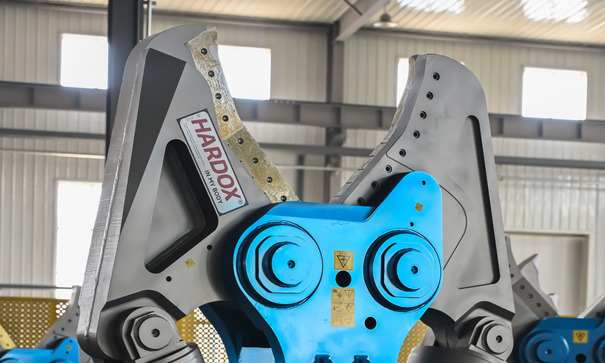
Two shears, one quotation sheet, three years apart A buyer comparing dual-cylinder shears is usually shown two machines in the same size class, at a similar price, both described as Hardox. Three years later one is still cutting to tolerance and the other has been rebuilt twice. Nothing on the quotation sheet explains the difference, but six things on the machine do — and all six can be checked before the order is placed rather than after the first crack. 1. Plate that can be traced to the mill JISAN builds shear jaws and blades from genuine SSAB Hardox plate, and the company has held the Hardox authorization for six consecutive years — it is issued against annual purchase volume, not against a request. Every shear, eagle shear and car dismantling tool carries the Hardox mark with a QR code that resolves to the plate, which matters because counterfeit "Hardox" is common in this trade and a workshop with a stencil can produce a convincing copy of the sticker. Ask to see the plate marking itself, not the certificate. HARDOX 400, 450 and 500 look different under the same light once you know what you are looking at. 2. One piece of steel, not a welded splice Most shears in this class are cut in sections and welded together. The weld is a stress concentration and a heat-affected zone in the same place, and it is where a frame eventually cracks. JISAN welds the body first and then machines it as one piece on a gantry machining centre, so there is no splice in the load path and the bores on both sides stay concentric. This is also why the shear does not "split" — the failure mode where the two halves drift out of alignment and the blades start to ride over each other instead of cutting. 3. A blade gap measured in hundredths of a millimetre The gap between the two blade bodies on a JISAN shear is 0.05 mm, and a correctly assembled unit will cut a sheet of A4 paper without any shim being added. That sounds like a parlour trick. It is not: a shear that needs shims at delivery will need re-shimming in the yard, and every re-shim is a day of production plus a question about what else was out of tolerance. The same standard runs across the range, from units for 3 to 5 tonne carriers up to the 60 to 80 tonne class. Small machines are not built to a looser tolerance; they are built to the same one. 4. The components you cannot see in a photograph Four items decide how a shear behaves after the first thousand hours: • Rotation motor. JISAN fits a Swiss-made plunger motor for the 360 degree rotation. It holds position under load, which is what "accurate positioning" actually means when you are cutting a hull plate in sequence. • Cylinder tube. Honed, not just bored. The surface finish is what the seal runs against. • Seals. Imported NOK. A seal is a cheap part that costs a shift. • Synchronising linkage. Twin cylinders with a linkage that keeps both jaws square to the load, rather than letting one side lead. 5. Protection for the part that breaks first Cylinder rods are the most exposed component on a shear. They sit where the material being cut can reach them, and a scored rod takes the seal with it. JISAN builds a guard over the rod area — a detail that costs almost nothing at the factory and prevents the most common unscheduled stop in a yard. 6. What happens in year two Durability decides whether the machine still cuts. Service decides whether it cuts this week. JISAN runs a 24 hour, 365 day service line on the "1030824" rule: 10 minutes to acknowledge, 30 minutes to a proposed solution, 8 hours to dispatch a warranty part, 24 hours to put an engineer on site for a problem that cannot be solved remotely. For a yard running a single primary shear, that fourth number is the one that matters. A shear waiting for a blade bolt is not a shear. How to use this list If you are comparing two quotations, ask for six things in writing: the plate grade and its mill marking, whether the body is machined as one piece or welded from sections, the blade gap and whether the unit is shim-free at delivery, the make of the rotation motor and the seals, whether the cylinder rods are guarded, and the warranty terms with the response times that go with them. A supplier who answers all six is selling a machine. A supplier who answers three is selling a price. Comparing shears for a yard? Send the carrier model, the material mix and the section thickness you cut most often, and we will send the six answers for the size class that fits, in writing, before you decide.

Six Checks That Tell a Good Shear From a Cheap One

Nov.21.2026
Copyright © 2026 Jisan Inc. All rights reserved.  |  Remry Design