
Buyers compare purchase prices. Almost nobody compares the price they will get back. For an attachment that runs eight hours a day in scrap or demolition, the exit value is a larger number than most purchase negotiations, and it is decided by decisions made at the factory, not at the resale yard.
A shear that costs a fifth more and sells for two fifths more after three years is the cheaper machine. That is the whole argument, and it is arithmetic rather than brand loyalty.
What actually sets the used price
Four things, in this order:
• Remaining wear surface. Jaw inserts, blade edges and the plate behind them. A buyer measures this with a tape before he starts the machine.
• Frame condition. Straightness, and cracks at the pivot and at the cylinder mounts. A bent frame is not a repair; it is a parts machine.
• Hydraulics. Chrome on the rods, seal condition, and whether the cylinders have been rebuilt and by whom.
• Paperwork. Warranty history, repair records, and whether the serial number is still supported for wear parts.
Everything a manufacturer does to raise durability shows up in the first two items, which is why material and process claims are worth reading carefully.
Where the difference is built
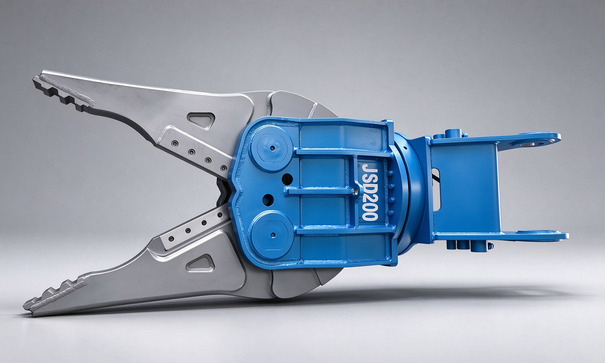
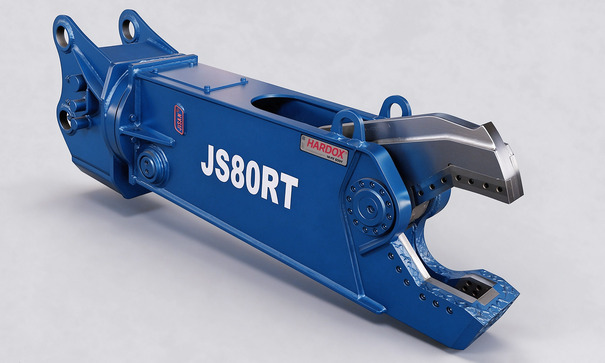
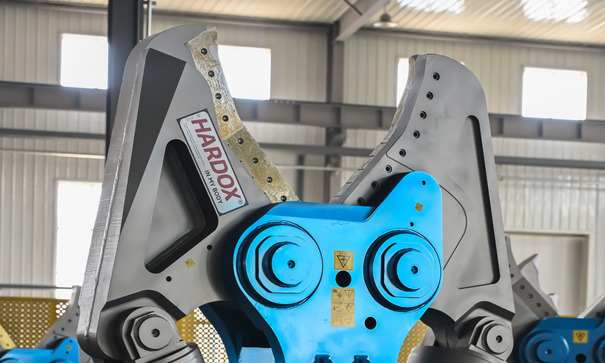
• Wear plate on the jaw bodies. JISAN builds shear jaws and blades from genuine SSAB Hardox plate. Against ordinary structural steel, the wear resistance is roughly four to five times higher, which is the difference between a jaw that is still dimensionally useful in year three and one that has been rebuilt twice.
• Q355B with wear plate on the grab bodies. On grapples and grabs, the structure needs stiffness rather than abrasion resistance; the teeth, the inner faces and the loaded edges are where the wear plate goes. A grab built this way does not need the annual hard-facing that a plain steel grab does.
• One-piece machining instead of welded splice. Splices are where cracks initiate, because a weld is a stress concentration and a heat-affected zone in the same place. Machining the load path as one piece removes the joint, and a machine without a splice does not develop the crack that a used buyer looks for.
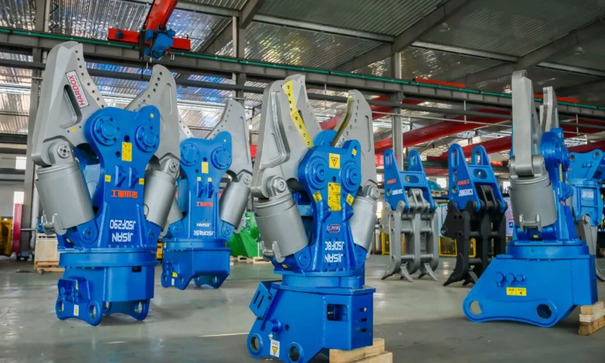
• Warranty that a used buyer can read. JISAN covers dual-cylinder shears for two years and grabs for one, with an automatic one-month extension at the end of the term. In the used market, a documented warranty period is the only third-party evidence that the machine was built to a standard rather than to a price.
The premium on paper
Industry resale data quoted by JISAN puts the gap at 20 to 30 percent: attachments with a complete warranty record and no major repair sell for that much more than equivalent units without them. The number will differ by market, but the direction does not — used buyers pay for evidence, and evidence is what a manufacturer either creates or does not.
What to check before you buy used
• Measure the remaining insert thickness against the new specification, and ask what a replacement set costs. On some machines the wear parts are worth more than the frame.
• Check frame straightness across the pivot bores, and look for cracks in the weld toes at the cylinder mounts with a penetrant test rather than by eye.
• Ask for the cylinder rebuild history, including who did the work.
• Confirm that the serial number is still supported. A machine whose wear parts are discontinued has no resale value regardless of condition.
The calculation worth doing
Purchase price plus repair hours plus downtime minus resale value, divided by tonnes processed. Most buyers run the first term and guess the rest. The yards that run all four tend not to buy the cheapest attachment on the quotation sheet — and they are usually the ones still trading five years later.
Replacing or adding a shear? Tell us the material and the duty cycle, and we will quote the unit together with the wear-part list and the warranty terms in writing, so the number you compare includes the parts you will actually need.