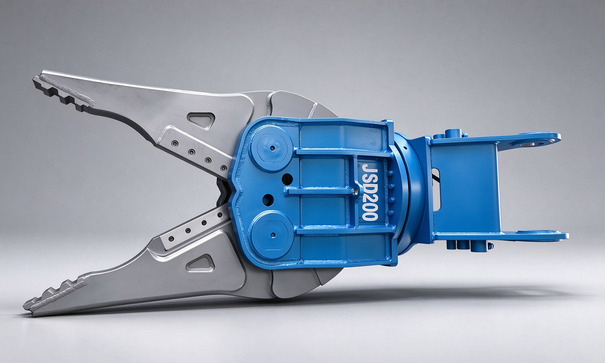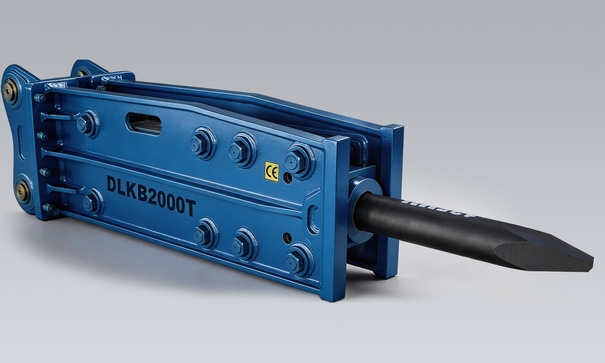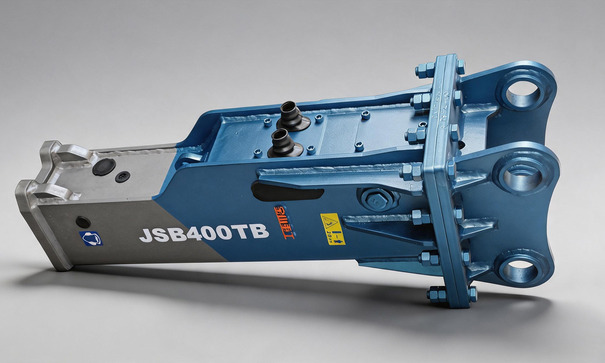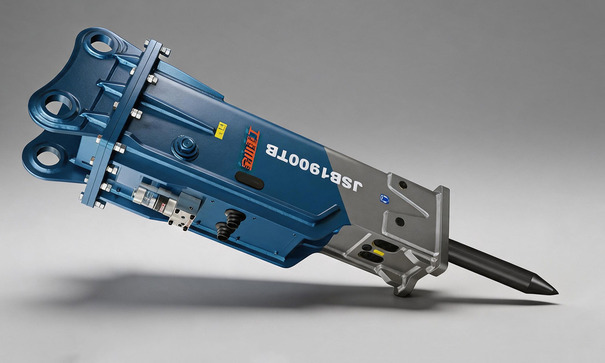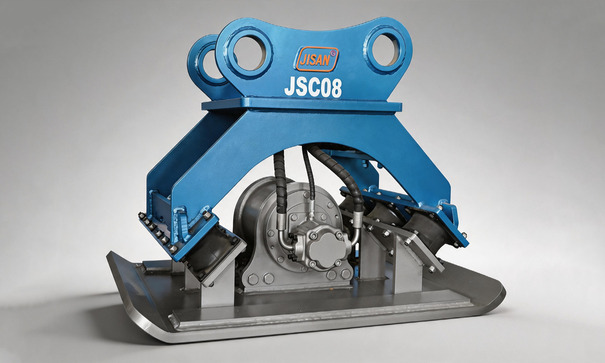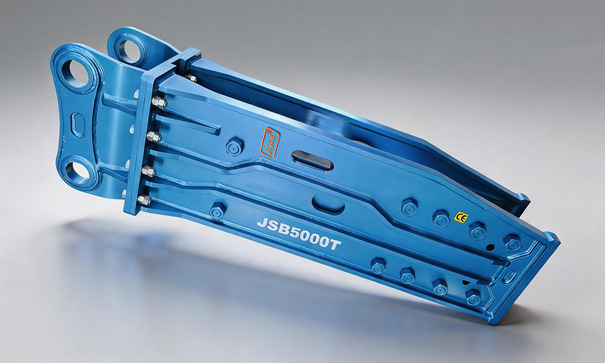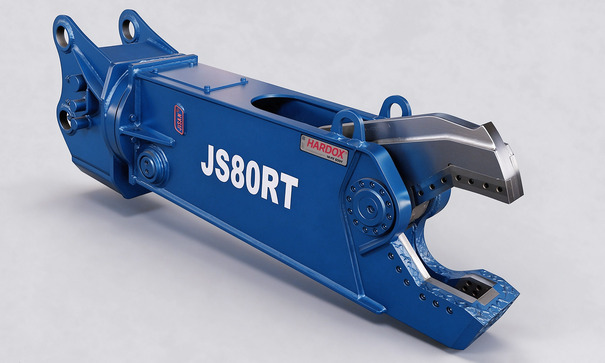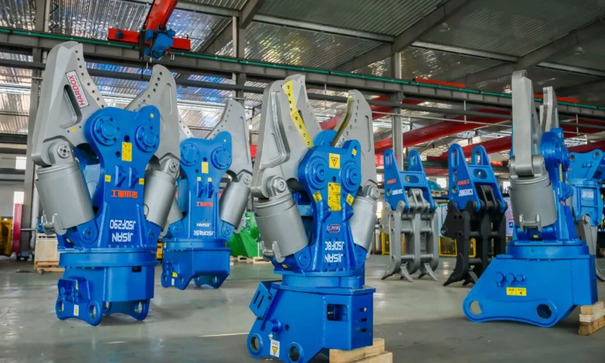

The same 30-tonne carrier will earn four different amounts depending on which yard it works in, and the difference is decided by what hangs on the end of the boom. Scrap, end-of-life vehicles, demolition and ship-breaking each punish a different part of an attachment. Specifying by catalogue rather than by site is how yards end up with a tool that is oversized for the daily work and undersized for the job that pays.
Scrap yard: cut where the pile is
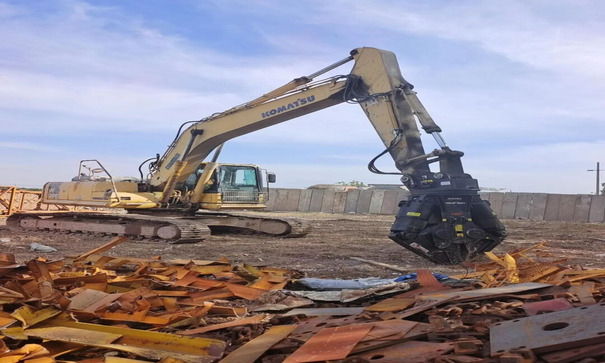
A yard‘s cost is dominated by handling, not by cutting. Material that is carried to a fixed shear is handled twice before it is processed; a shear on a carrier cuts it where it lies.
• What to fit: a dual-cylinder shear sized to the carrier, with a jaw opening that swallows the bulk of the material rather than the largest single piece in the yard.
• Why it pays: no flame, no fume, no hot-work permit — which matters more every year in yards inside city limits — and one shift of shear work replaces roughly three shifts of torch-and-handling in JISAN‘s own field records, with handling and transport costs falling by 40 to 60 percent.
• What to watch: blade condition weekly, not monthly. A dull insert raises cycle time before it raises anyone‘s attention, and the loss shows up as fuel and operator hours rather than as a maintenance line.
End-of-life vehicles: two tools, one line
A depolluted car is a mix of thin panels, structural steel and castings, and no single attachment is efficient across all three.
• What to fit: a car dismantling tool for shell and structure separation, a dual-cylinder shear for frame rails and drivetrain, and an eagle shear where the cut has to be clean because the material is sold sorted.
• Why it pays: JISAN‘s own dismantling line runs at about seven minutes a car, with the mechanical cut replacing three to five times the labour of hand tools — and the recovered material leaves in saleable condition rather than as mixed scrap.
• What to watch: the cleanliness of the cut. If the yard sells by grade, a crushed edge is a downgrade, and the eagle shear is the tool that prevents it.
Demolition: crush, do not blast
Urban demolition is a permitting problem before it is a cutting problem.
• What to fit: a pulverizer that crushes concrete and separates rebar in one pass, on a carrier small enough to work between structures.
• Why it pays: no blasting permit, no dust plume, no vibration complaint from the neighbouring building — and the rebar comes out clean enough to sell rather than to re-sort.
• What to watch: jaw width against slab thickness, and rebar density against jaw force. A pulverizer that stalls on every second slab is the wrong size, not a weak tool.
Ship-breaking: plate thickness governs everything
Hull plate is the hardest duty in the business: thick, stacked, and often still attached to structure that has to be cut in sequence.
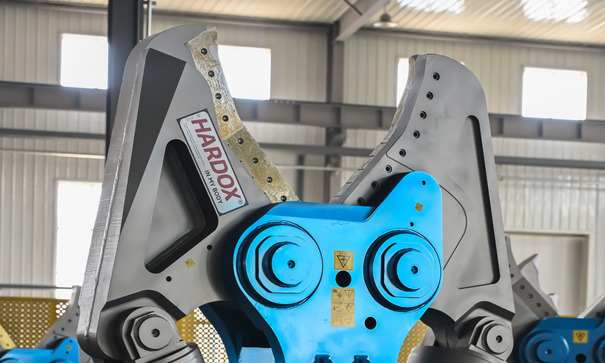
• What to fit: a dual-cylinder shear for the heavy sections, with Hardox jaws and a frame stiff enough to hold alignment through a full shift, plus an eagle shear for the plate work where a clean cut saves a second pass.
• Why it pays: a properly sized dual-cylinder shear cuts hull plate of 20 mm and above without the torch work and the hot-work crew that go with it. The limit is not the blade; it is whether the frame stays straight under continuous load, which is why the frame is machined as one piece rather than fabricated from welded sections.
• What to watch: reach and rotation. On a long boom, attachment weight costs lifting capacity at the tip, and a shear that is 400 kg too heavy is a shear that cannot be positioned accurately.
The rule that applies to all four
Specify for the weekly case, not the annual exception. The exception can be rented, hired in, or cut with a torch once a quarter. The weekly case is what the carrier does every day, and that is the number the attachment should be sized against.
Tell us what your yard processes in a normal week — material mix, section thickness, tonnes per shift — and we will propose the attachment and the wear-part kit for that case, plus a second option for the material that falls outside it.