

Ten speakers, one afternoon, and three conclusions at the end of it. The conclusions matter more to buyers than to sellers, because all three answer the same question: where is the value of an attachment actually proven?
One: value lives in the working condition, not the specification sheet
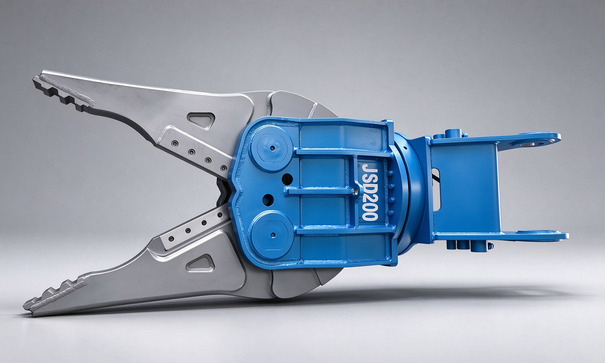
A specification sheet gives you cutting force, jaw opening, flow. It does not tell you how many bites a given piece of material will take. The same shear behaves differently in a scrap yard and on a ship-breaking quay, because material mix, continuous operating hours and operator habit all differ.
The most common selection error in this industry is matching the largest cutting force to the hardest single piece in the yard. The result is that 90 percent of daily work runs at less than half capacity, and the machine spends its life in an inefficient band.
Two: carrier and attachment have to be specified together
The carrier‘s flow, pressure, lift capacity at reach and pin dimensions set the ceiling for the attachment. The attachment‘s opening, weight and cycle time in turn determine how the carrier should be used.
Buying them separately has a very concrete consequence: brackets modified on site, hydraulic settings fudged, and a machine that turns out not to be able to place the load where it was supposed to. Having carrier manufacturers and attachment makers at the same table was the point of the conference — moving fit-up forward into the design stage instead of the delivery bay.
Three: an ecosystem travels further than a single company
This is most visible in export markets. Chinese attachments competing in the Middle East, Europe and Southeast Asia are not losing on product. They are losing on standards, certification, spare parts and service networks — things no single company can build alone.
The Open-S fully automatic quick-coupler standard presented by Steelwrist, the review of the European attachment market by Simex, and the Saudi market experience from Joinstar were three views of the same problem.
What the three add up to
Underneath them is a plainer judgement. Attachments have lived on being cheaper than a carrier and faster than a torch. The next stage is proving what they are worth.
That proof does not come from a better-written specification. It comes from putting the machine on a real site for long enough, then seeing whether it still cuts to tolerance three years later.
For a buyer, the three consensuses convert into three questions: has this configuration run on material like mine, were the carrier and the attachment calculated together, and will spare parts still be available in three years? Anyone who can answer all three rarely buys the wrong machine.